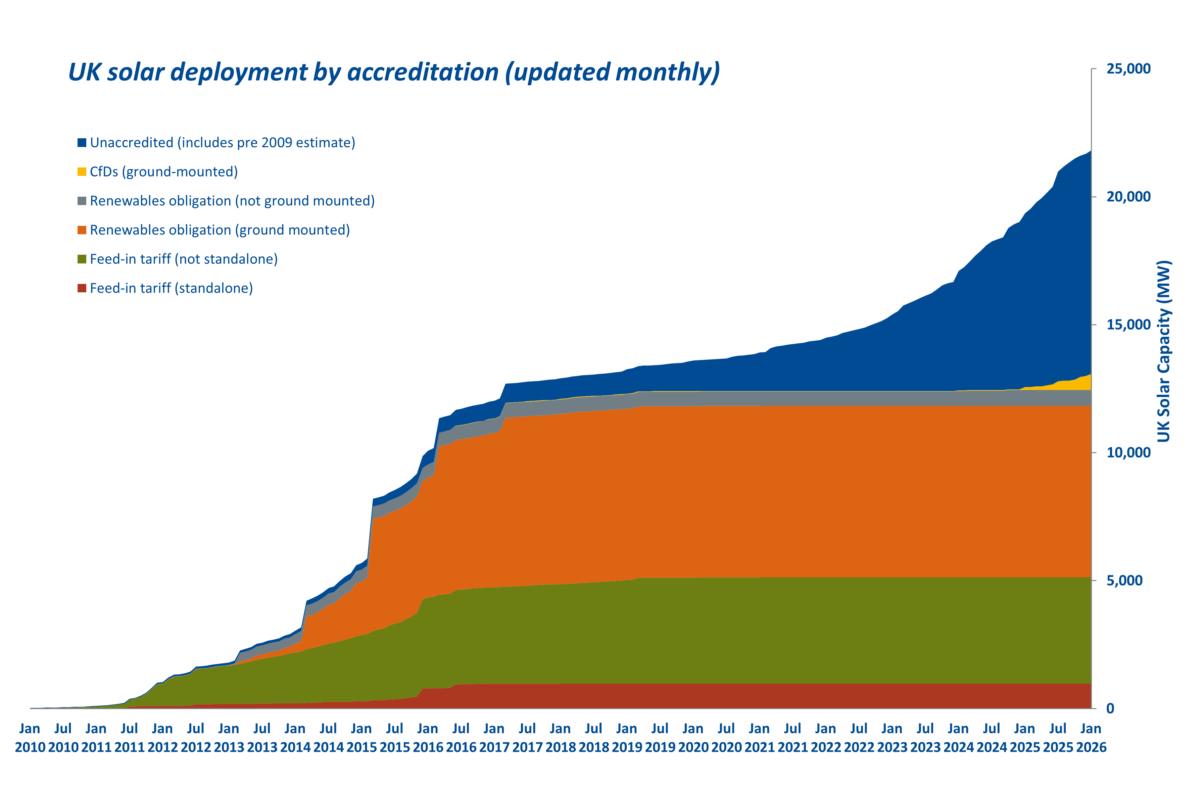
UK deployed solar capacity hit 21.8 GW across 1,951,000 installations at the end of January 2026, according to the latest provisional government data, with a strong start to the year for the small-scale segment ahead of major new subsidies coming into force.
The Department of Energy Security and Net Zero (DESNZ) recorded 131 MW of new capacity in January 2026, down on the 339 MW added in January 2025, however these numbers are subject to revision as new data incorporated.
Data recorded by accreditation body MCS for systems up to 50 kW painted a more positive picture. Small-scale installations had their second strongest month on record with 17,154 recorded installations – just 521 installations short of the 17,675 recorded in January 2025.
More rooftop installations in combination with a step change in utility-scale solar deployment will be needed to hit the UK government target of at least 45 GW solar capacity by 2030, but there is evidence that billions of pounds of subsidy support earmarked for UK solar will enter a market that has been rebuilt significantly since entering a six-year slump in 2017.
January 2026 is the fourth year in succession that small-scale deployment has exceeded 12,000 installations in the first month of the year. MCS certified solar installations fell off a cliff in January 2017 from a high of 15,291 in 2016 as households rushed to beat a downward revision of the UK feed-in tariff rate paid to consumers exporting electricity to the grid. Installation volumes did not recover until 2023.
The UK government plans to further accelerate rooftop solar deployment through its Warm Homes Plan, a $20 billion package that includes cash grants and state-backed loans for solar and battery storage installations. It also intends to make PV effectively mandatory for new build homes in England in its next update to building regulations.
Accelerated utility-scale deployment should take place in 2026, too. Commissioning deadlines loom for a raft of projects megawatt-scale projects with contracts for difference (CfDs) secured through government auction.
There are 23 solar projects with a CfD operating in the United Kingdom according to the latest DESNZ data, three of which were commissioned in January 2026. CfD backed plants make up a relatively small proportion of total deployed PV capacity in the United Kingdom but this is set to change. Analysis of the public facing CfD register carried out by pv magazine in December 2025 suggests the number of CfD supported plants in operation could more than double in 2026, due to the volume of projects with commissioning deadlines approaching.
The bulk of PV installations in the United Kingdom are domestic, but these only account for 30% of capacity. CfD capacity has also accounted for a relatively small proportion of deployment to date – increasing from 23 MW at the end of 2024 to 546 MW at the end of 2025. With more CfD projects expected to come online in 2026 than any year prior and greater state support for residential and community solar expected soon, an annual deployment record seems likely despite provisional January data lagging 2025 reporting.