Aresearch group from China’s Shandong Police College has developed a novel soft chemical treatment to improve the efficiency of kesterite-structured copper–zinc–tin selenide (CZTSe) solar cells, according to pv-magazine.
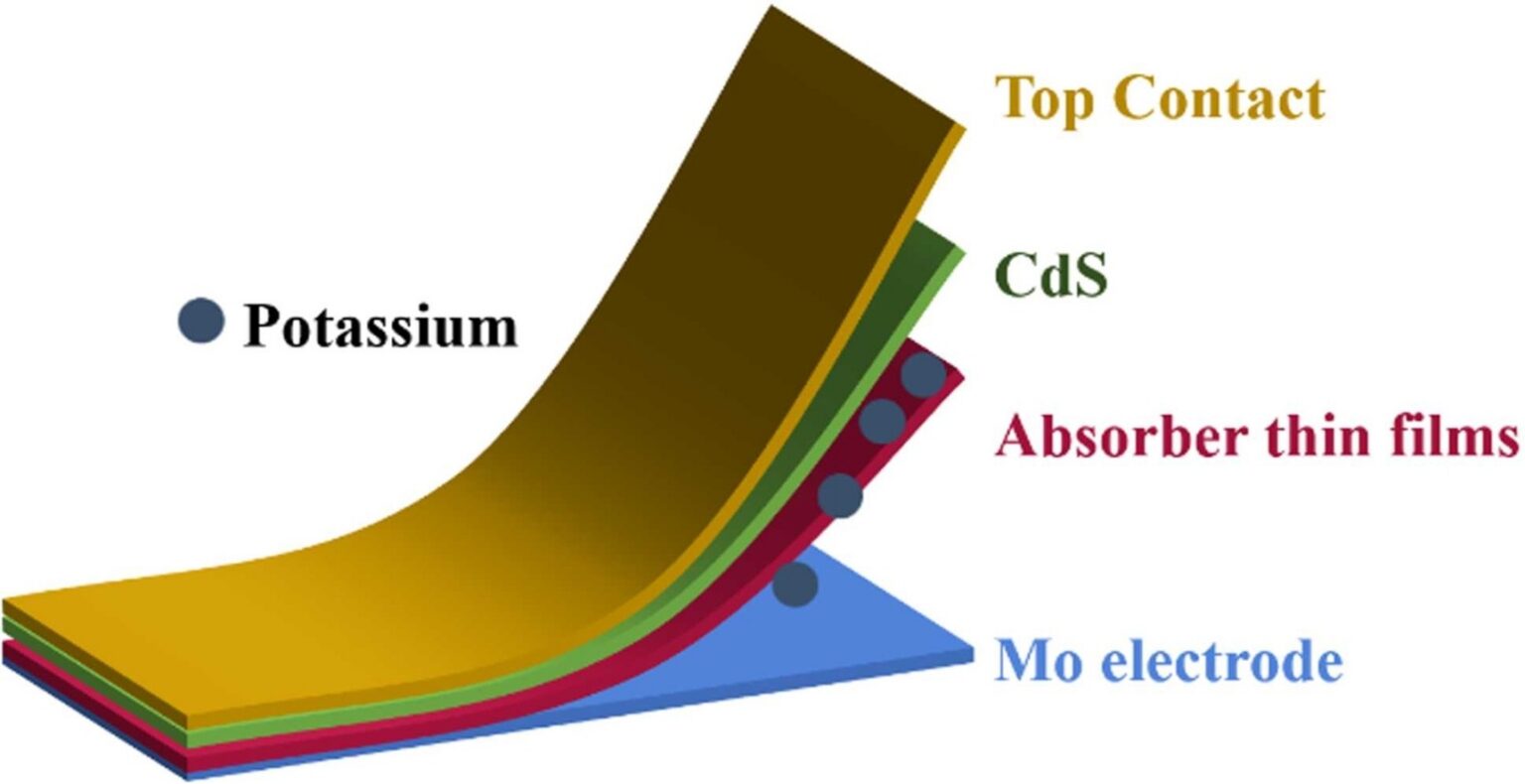
“At present, the mechanism of alkali metal treatment of kesterite solar cells still needs to be further studied,” the researchers explained. “Sodium (Na) or potassium (K) treatment can significantly boost the performance of thin-film solar cells. Alkali metal treatment can passivate the absorber surface, reduce grain-boundary defects, optimize crystal quality, and increase carrier concentration. The process of alkali metal treatment of the solar cell absorber layer also has a very important impact on the solar-cell device.”
With the proposed method, the absorber layer was prepared using a potassium fluoride (KF) solution.
The team fabricated the CZTSe solar cells on soda-lime glass (SLG) substrates coated with a molybdenum (Mo) back contact. Metallic copper (Cu), zinc (Zn), and tin (Sn) precursor layers were deposited via magnetron sputtering and adjusted to a copper-poor, zinc-rich composition. The precursors were then immersed in KF solutions at concentrations of 0, 3, 6, or 9 mmol/L for 20 minutes, followed by drying at 80 C for 20 minutes.
Subsequently, the samples were selenized at 550 C in a selenium atmosphere to form the CZTSe absorber layer. The solar cells were completed by depositing a 50 nm cadmium sulfide (CdS) buffer layer, followed by intrinsic zinc oxide (i-ZnO), aluminum-doped zinc oxide (AZO), and nickel/aluminum (Ni/Al) front contacts. The final device structure was SLG/Mo/CZTSe/CdS/i-ZnO/AZO/Ni:Al.
Following fabrication, the team characterized the devices using scanning electron microscopy (SEM), current density–voltage (J–V) measurements, external quantum efficiency (EQE) measurements, and capacitance–voltage (C–V) measurements. The results show that CZTSe performance improved with increasing KF concentration up to an optimum of 6 mmol/L. However, further increasing the KF concentration to 9 mmol/L led to performance degradation.
Specifically, the device treated with 6 mmol/L KF achieved an efficiency of 8.04%, an open-circuit voltage of 0.392 V, a short-circuit current density of 34.3 mA/cm², and a fill factor of 59.7%. These results compare with the reference device (without KF treatment), which showed values of 6.59%, 0.332 V, 33.7 mA/cm², and 58.8%.
To further understand the underlying mechanisms, the team used wxAMPS simulation software to study how interface defects and carrier density influence device performance. By varying these parameters, they found that reducing interface defects significantly improved efficiency and Voc by suppressing carrier recombination. In contrast, increasing carrier density was found to degrade device performance.
“It has been demonstrated that potassium can promote the growth of CZTSe grains during high-temperature selenization and reduce void formation during film growth,” the team concluded. “In addition, the soft KF treatment also provided an excess potassium source and effectively suppressed surface decomposition. In particular, it reduced the loss of Sn through the desorption of SnSe(g), resulting in an improved CdS/CZTSe interface.”
The proposed technique was presented in “Potassium processing interface engineering for carrier regulation of efficient CZTSe solar cells,” published in Materials Today Communications.