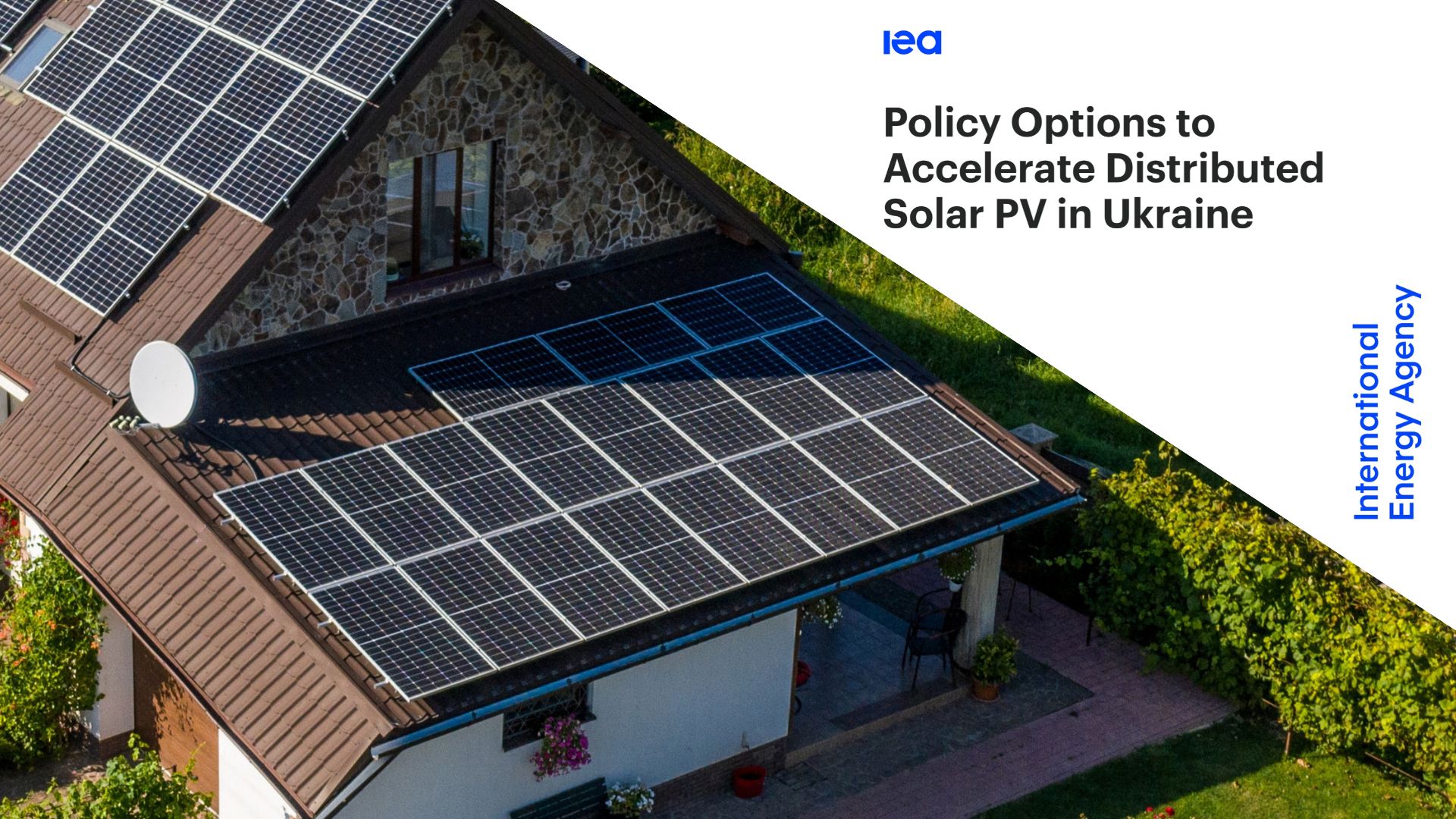
The IEA has proposed three potential policies to increase the deployment of distributed solar and BESS in Ukraine.
The agency’s latest report says distributed solar has played a key role in restoring and adding energy capacity in Ukraine since Russia’s invasion, which has repeatedly targeted energy infrastructure.
Estimates from the agency add that Ukraine needs to deploy around 24 GW of distributed PV before the end of 2030, alongside 5.6 GWh of BESS, to create a more decentralized and secure power system and achieve objectives featured in its national energy and climate plan. As of 2024, the country had around 7 GW of distributed solar.
Ukraine’s existing policies for distributed solar include low interest loans provided by the government, available only in conjunction with the recently-introduced net-billing scheme. The net-billing scheme allows households to sell surplus electricity at the hourly wholesale electricity price, minus distribution system operator charges and taxes. IEA says the current residential electricity price is around €84 ($97.87)/MWh but will eventually increase once subsidies are phased out.
A Green Tariff is also in place, offering around €135/MWh for electricity from solar belonging to private households, set to cease payments after 2029.
The report says that in the context of recent deployment trends, incentives and current retail electricity prices, existing policies could lead to an additional 3.1 GW of solar capacity and another 1.4 GWh of BESS by 2030, requiring an estimated government spend of around €1.4 billion.
It goes on to suggest three potential policy options covering 2025-2030 that, while requiring more financial investment, would help bring the level of deployed solar and BESS beyond that of existing incentives.
The first proposes the introduction of an investment grant. IEA suggests the direct incentive should cover at least 60% of a total investment cost for a small-scale solar-plus-storage system. It also recommends a fixed and stable tariff for selling the entire production of the generated electricity to the energy supplier or another state-owned entity as a way to provide additional financial support and mitigate risk.
IEA says that while this policy would facilitate a fast build out of 24 GW of solar and 5.6 GWh of BESS, it entails high cost for the government, estimated at €17.5 billion to the end of the decade.
The second policy option focuses on enhancing existing incentives, by making low- or zero-interest loans more widely available by providing capacity building for local banks, or by making local administrations one stop shops for the loan.
Loans should be made available to prosumers, the report adds, helping to reduce existing administrative barriers. It also suggests the government could bring in a new feed in tariff exclusively for distributed solar beyond 2030, available only if the installation is deployed before the end of the decade.
IEA forecasts enhancing current policies would cost around €16.1 billion by 2030 and result in around 18 GW of solar and 5.6 GWh of BESS being deployed.
The third option introduces a real-time/hourly self consumption scheme. Described as similar to the current net-billing scheme, it would ruminate surplus electricity with an extra benefit payment in addition to the wholesale market price. It should also include a direct incentive for BESS covering 25% of the costs of the asset, IEA suggests.
It is estimated this policy would cost around €1.9 billion, helping to deploy 7 GW of solar and 3 GWh of BESS by the end of the decade.
Ukraine deployed 500 MW of solar across the first half of 2025, according to provisional figures from the country’s solar association.